API for attaching props to rigged characters: what game teams need in 2026
Attaching a weapon to a hand, a shield to a back, or a tool to a belt should be a systematic operation. Yet many game studios still handle prop placement through manual transforms and scene-specific fixes. An API for attaching props to rigged characters changes that by making placement repeatable, automated, and testable across multiple character models.
The problem with manual prop attachment
Manual attachment works for a single hero character. It breaks down when a team manages dozens of character variants, modular equipment, or user-generated loadouts. Artists spend time aligning pivots, adjusting rotation for each skeleton, and redoing work after a rig update. These manual steps also introduce small errors that are hard to detect until animation or gameplay testing.
What an attachment API should handle
- Socket detection on the skeleton, such as hands, spine, hips, or head
- Automatic orientation from the character rig
- Parent constraint creation without destroying existing skinning
- Batch processing for multiple characters and multiple props
- Validation of collisions or penetration before export
How an API changes the production workflow
A well-designed API for attaching props to rigged characters turns equipment setup into a pipeline stage. A technical artist or developer can define attachment rules once, then apply them to every compatible skeleton. New props are validated against those rules before they enter the game project. This reduces the number of art tickets and keeps animation-ready files consistent.
For example, a studio preparing a shooter in 2026 can call an attachment service for each new weapon model. The API returns the weapon parented to the correct hand socket, with the pivot aligned to the grip. From there, the team only validates the result rather than building the setup from scratch.
Key benefits for game development
- Fewer manual transforms and fewer human errors
- Faster iteration when character proportions change
- Consistent placement across NPCs, enemies, and player models
- Easier integration with build automation and continuous asset validation
- Reusable attachment rules across future projects
What to look for in an attachment API
First, the API must accept the character and prop formats already used by the studio. Common formats include FBX, glTF, and USD. Second, it must respect the existing skeleton hierarchy. Third, it must support server-side processing for large batches without consuming local workstations.
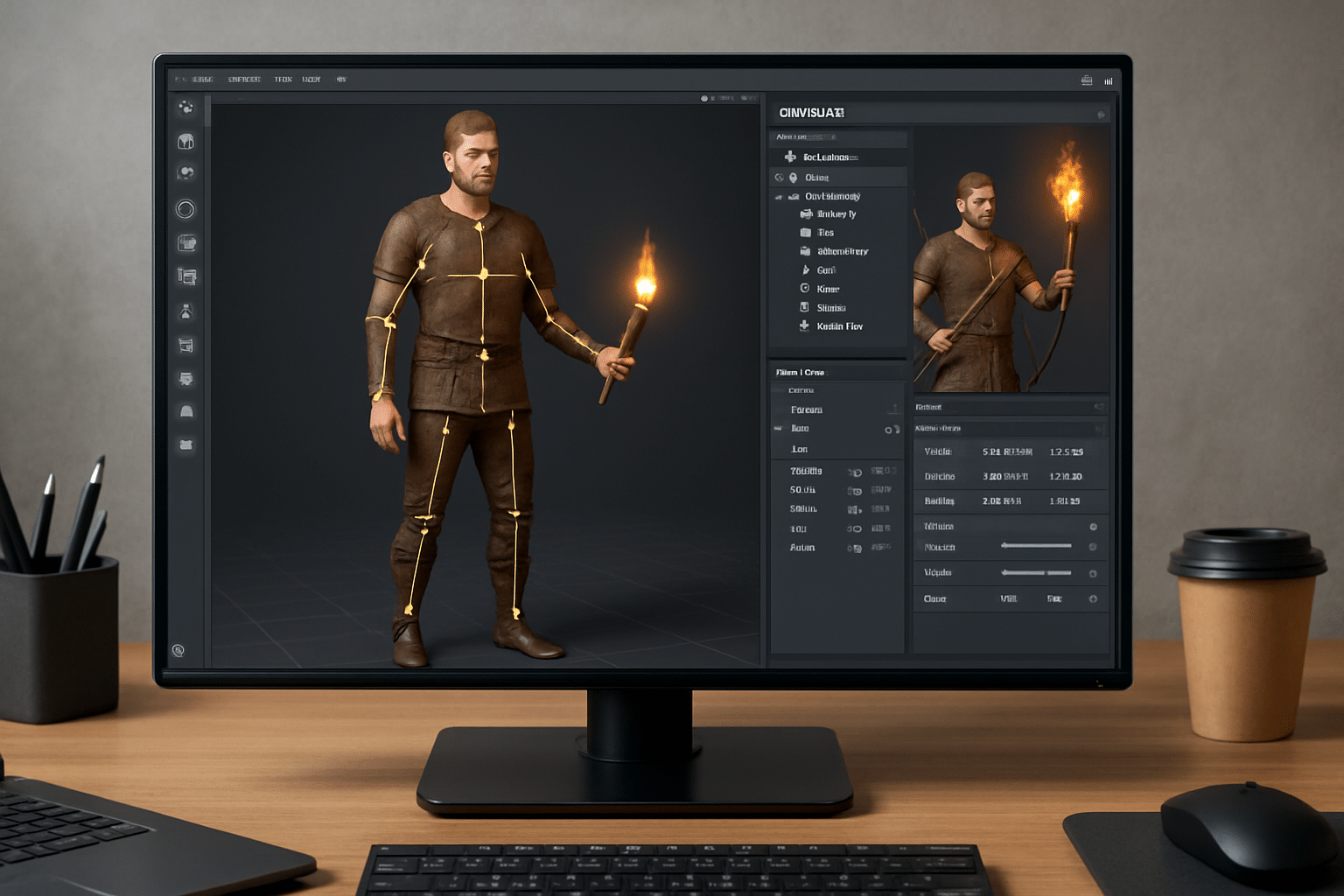
GripForge offers an API designed for attaching props to rigged characters, with a focus on game-ready characters and accessories. The service is built to take a character mesh, a weapon or tool mesh, and a socket definition, then return an aligned result that can be reviewed or exported. This approach fits teams that need to process many loadout combinations without opening a DCC tool for each one.
Questions to ask before choosing a provider
- Does the API return a usable hierarchy or only a transform?
- Can it handle non-standard bone names through mapping?
- Does it support batch jobs?
- Is there a validation step for mismatched scales or rotations?
- Can the result be previewed before download?
Integration with an MCP server for 3D character prop integration
Game AI tools increasingly expose model context protocol servers to connect design tools, asset pipelines, and game engines. An MCP server for 3D character prop integration can make attachment functions available to AI agents, editors, or internal automation. In this setup, a request does not need to come from an artist; it can be issued by a build script, a QA tool, or a design interface.
GripForge positions its attachment tools for this type of integration. Teams can use the service through direct API calls or through automation layers that treat prop attachment as a structured action. That makes the workflow accessible to both technical artists and engineering teams.
Typical pipeline with an attachment API
- Character mesh and rig are uploaded or referenced.
- Prop assets are uploaded with their intended socket.
- The API processes alignment and parenting rules.
- The result is validated against project constraints.
- The final asset is exported to the game project.
What the market offers in 2026
Most general DCC tools can attach objects manually. The difference in 2026 is automation. Some game engines provide basic socket systems, but these often work only inside the engine and do not help during modeling or pre-production. Dedicated attachment APIs close the gap between asset creation and runtime readiness. When choosing a tool, prioritize the ability to preserve rigging, support multiple character types, and expose the function through a stable API.
Conclusion
An API for attaching props to rigged characters saves time, reduces placement errors, and enables equipment-heavy games to scale their content production. GripForge brings this capability together with a shared asset library and character generation features, making it a practical option for studios that want fewer manual steps in their prop pipeline. Evaluate how many character-prop combinations your team will produce in 2026, and choose a service that can handle that volume consistently.